Charity Fashion Show, Ipswich - March 2010 from Stuart Hilpert on Vimeo.
Thursday, 8 April 2010
Charity Fashion Show
Here is the video I shot and Edited alongside Over 60 other volunteers for a charity Fashion show. sadly like all the videos produced in college at the moment, the editing program drops frames within the video. Which become noticeable when compressed and put online. However I hope you enjoy watching anyway.

Tuesday, 23 February 2010
Sunday, 31 January 2010
Monday, 9 November 2009
Tuesday, 20 October 2009
8 shot journey evaluation
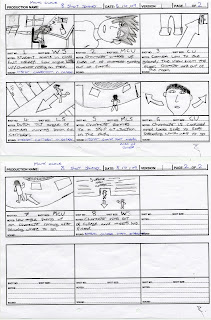
Before filming my 8 Shot jouney I had to first create a storyboard. The story board had to show all the shots that I would be filming as well as a description of what is taking place within that shot. A story board also has to meantion what shot type you want to use as well as any sound that takes place within the shot. As the 8 shot Journey I created was meant to be a silent task I didnt meantion anything about sound as there would be any in the film.
Once I'd drawn my storyboard I began 'striping' my tape ready for recording. Striping basically means recording nothing but a black screen. This is important because it helps you aviod taping over footage you recorded. After I striped my tape I gathered together a tripod and camera reday to film.
I directed the 8 shot journey with the help of David Howe as my talent. David's job was to do everything I told him to do. I tried to have every focal point covered throughtout each shot, which turned out to be trickier than I first thought it would be. The reason it proved tricky was because as a film maker I had to think how I'd show depth that would make the shot seem interesting instead of just a single character walking off screen. Once I'd added depth to the shot, I told David to do a run through without the camerea recording to double check that he knew what wanted him to do. I did this for Every shot I filmed and it worked out quite well as we only had about 4 retakes to film, and this partly because people walked in the way of the shot which distracted David.
Once I'd finished filming I uploaded all my footage onto ADOBE Final cut pro. Final cut pro is a video editing software program that is to a professional level. During uploading you need to place 'set in' and 'set out' points, this basically divides up the footage into clips. These clips then need to be 'batched' for them to work on the program ready to be edited. Once I had batched all my video clips I dragged them into a timeline placed at the bottom of the program. This allows to place the clips in any order I want to create a sequence. Once I did this I saved the project as 8 shot journey and then added titles at the beginning and at the end of the sequence and then burned the whole thing to a disc. Once I'd burned the video to Disc I played the disc and uploaded it onto youtube.
Overall the project went pretty well the only thing that went badly was caused by my own human error, that was that i forgot to remove the sound from the video meaning you can hear my voice on the video at the begining 'saying action.' Im future projects I will double check the audio before uploading it online.
Once I'd drawn my storyboard I began 'striping' my tape ready for recording. Striping basically means recording nothing but a black screen. This is important because it helps you aviod taping over footage you recorded. After I striped my tape I gathered together a tripod and camera reday to film.
I directed the 8 shot journey with the help of David Howe as my talent. David's job was to do everything I told him to do. I tried to have every focal point covered throughtout each shot, which turned out to be trickier than I first thought it would be. The reason it proved tricky was because as a film maker I had to think how I'd show depth that would make the shot seem interesting instead of just a single character walking off screen. Once I'd added depth to the shot, I told David to do a run through without the camerea recording to double check that he knew what wanted him to do. I did this for Every shot I filmed and it worked out quite well as we only had about 4 retakes to film, and this partly because people walked in the way of the shot which distracted David.
Once I'd finished filming I uploaded all my footage onto ADOBE Final cut pro. Final cut pro is a video editing software program that is to a professional level. During uploading you need to place 'set in' and 'set out' points, this basically divides up the footage into clips. These clips then need to be 'batched' for them to work on the program ready to be edited. Once I had batched all my video clips I dragged them into a timeline placed at the bottom of the program. This allows to place the clips in any order I want to create a sequence. Once I did this I saved the project as 8 shot journey and then added titles at the beginning and at the end of the sequence and then burned the whole thing to a disc. Once I'd burned the video to Disc I played the disc and uploaded it onto youtube.
Overall the project went pretty well the only thing that went badly was caused by my own human error, that was that i forgot to remove the sound from the video meaning you can hear my voice on the video at the begining 'saying action.' Im future projects I will double check the audio before uploading it online.
8 shot video
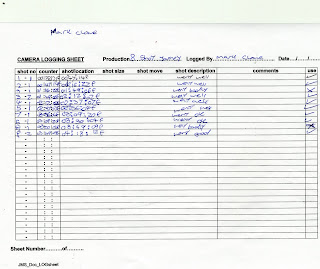
My Storyboard and Log sheet for my 8 Shot Journey: The storyboard is a visual version of my 8 shot Journey hand drawn on paper. A log sheet is a listed document of all the shots you have filmed including number of takes used to track how well the filming went. A good tracking sheet can aid the director when editing because it should list the frame number and how far into the tape you are, this is usually shown as a number. Heres an example of how it should look: 10:56:12 the first two nubers relate too time and last number relates to the number of frames, the camera will play out 24 frames a second.
Here is the youtube link to my 8 Shot Journey video, that I had to make for my video task.


Here is the youtube link to my 8 Shot Journey video, that I had to make for my video task.
Video Production
For the video project we had to create 'a short film' which had to be 8 shots in length and had to tell the story of a character's journey from one place to another. Before making a short film first we had to understand what makes a good short film, as well as the how to film a short film.
Their are three stages In Video production: pre-production, Production and Post-production.
Pre-production
This where you write the script, finding the locations where filming will take place, prop building, set design, auditions, etc. Everything that will be needed during production is planned out in pre-production basically.
Production
The production stage is when you record the film/sound and gather any necessary sound FX.
Post-production
Post-production is when you upload all the footage recorded as well as all the sound recordings and start editing. Editing is where you remove any 'takes' that went badly and organise the footage into what will become the finished film. Editing is also where you add any special effects that are needed to make the finishing touches to the film. Lastly post-production ends with a finished film either burnt to a disc or saved as a video file and put online.
Cinematography
A film is made up of 'frames' that usually play at 24 frames a second to create the illusion of motion on screen. A single 'shot' is made up of continuous motion of frames moving at 24 frames a second until the shot ends. A number of shots make up a 'scene.' Scenes are linked together to form a 'sequence.' Sequences make up a Programme or film.
Shot Types

The picture shows all the different shot types.
When filming a scene first you film the whole scene as a 'wide shot' this is so if their are any problems in editing later you always have a safety shot to fall back on. Wide shots are also good for establishing the scene because it reveals a lot of information to your target audience, such as the location, the characters, etc. After you film the 'wide shot' go in closer to the action and focus on the Key characters as this allows the audience to know who the hero of the story is easily, the best shot to use for this is 'mid-close up' or 'close up' as it allows the audience to zoom in automatically on that character.
Rule of 3rds

The rule of 3rds basically means that when setting up a shot you divide the display screen into a grid 3x3 and set the scene up like the one above: the water is within the bottom three squares and the buildings are in the middle block of squares and the sky is along the top three squares. The reason for this is because its easy on the eye, and just nice to look at when its laid out like this. I used this scene because it was the easiest example to explain the rule with, but the rule of 3rds works on other shots too like close ups.

180 degree line rule

when filming a scene imagine that their is line across the floor, you must not cross this line when filming throughout the whole scene, no matter how many shots you do because for example if your character is walking right to left, they will always appear to walk in that direction no matter where you place your camera on this invisible line unless you cross it, because then it look like they are walking from left to right instead of right to left even though they are still walking that direction. You can shoot either side of the line but you must never cross the line when filming unless you show a camera move physically moving across the line. The only other time you may break this rule is of course unless you want to confuse the audience because in that case it becomes a stylistic thing that if done effectively can look really good on screen.
Stylistic options
the use of diagonal lines can add interest to the shots as they are have nice composition and provide energy to a shot. whereas curved lines can appear graceful and are very easy on the eye compared with straight lines.


Another interesting option is how you choose to have your focus for your shot, you could have it all in Deep focus or maybe decide to have shallow focus. deep focus will have everything in the shot in focus and shallow focus could have only the foreground in shot.


As short film makers you must remember to include something in every 'action plane' action planes are basically foreground, middle ground, background.

Rules for short films
(1) Keep it simple, no need to over complicate the plot.
(2) Highly visual, try to tell the story with just the imagery.
(3) Not many characters, because the story is only short, theirs no need for lots of characters.
(4) Not many locations, again for the same reason as for characters.
(5) Humour/fantasy, most short films are surreal because its easier to make a short film about something surreal compared to serious drama piece short film.
(6) End on a climax, this is to bring all the lose ends up in one go without leaving too many questions at the end.
(7) Anti-narrative, you don't have to necessarily obey normal narrative structure, you may want to begin your story at the very end for example rather than the beginning.
(8) Avoid cliché, because it is isn't original and not very creative.
Their are three stages In Video production: pre-production, Production and Post-production.
Pre-production
This where you write the script, finding the locations where filming will take place, prop building, set design, auditions, etc. Everything that will be needed during production is planned out in pre-production basically.
Production
The production stage is when you record the film/sound and gather any necessary sound FX.
Post-production
Post-production is when you upload all the footage recorded as well as all the sound recordings and start editing. Editing is where you remove any 'takes' that went badly and organise the footage into what will become the finished film. Editing is also where you add any special effects that are needed to make the finishing touches to the film. Lastly post-production ends with a finished film either burnt to a disc or saved as a video file and put online.
Cinematography
A film is made up of 'frames' that usually play at 24 frames a second to create the illusion of motion on screen. A single 'shot' is made up of continuous motion of frames moving at 24 frames a second until the shot ends. A number of shots make up a 'scene.' Scenes are linked together to form a 'sequence.' Sequences make up a Programme or film.
Shot Types

The picture shows all the different shot types.
When filming a scene first you film the whole scene as a 'wide shot' this is so if their are any problems in editing later you always have a safety shot to fall back on. Wide shots are also good for establishing the scene because it reveals a lot of information to your target audience, such as the location, the characters, etc. After you film the 'wide shot' go in closer to the action and focus on the Key characters as this allows the audience to know who the hero of the story is easily, the best shot to use for this is 'mid-close up' or 'close up' as it allows the audience to zoom in automatically on that character.
Rule of 3rds

The rule of 3rds basically means that when setting up a shot you divide the display screen into a grid 3x3 and set the scene up like the one above: the water is within the bottom three squares and the buildings are in the middle block of squares and the sky is along the top three squares. The reason for this is because its easy on the eye, and just nice to look at when its laid out like this. I used this scene because it was the easiest example to explain the rule with, but the rule of 3rds works on other shots too like close ups.

180 degree line rule

when filming a scene imagine that their is line across the floor, you must not cross this line when filming throughout the whole scene, no matter how many shots you do because for example if your character is walking right to left, they will always appear to walk in that direction no matter where you place your camera on this invisible line unless you cross it, because then it look like they are walking from left to right instead of right to left even though they are still walking that direction. You can shoot either side of the line but you must never cross the line when filming unless you show a camera move physically moving across the line. The only other time you may break this rule is of course unless you want to confuse the audience because in that case it becomes a stylistic thing that if done effectively can look really good on screen.
Stylistic options
the use of diagonal lines can add interest to the shots as they are have nice composition and provide energy to a shot. whereas curved lines can appear graceful and are very easy on the eye compared with straight lines.


Another interesting option is how you choose to have your focus for your shot, you could have it all in Deep focus or maybe decide to have shallow focus. deep focus will have everything in the shot in focus and shallow focus could have only the foreground in shot.


As short film makers you must remember to include something in every 'action plane' action planes are basically foreground, middle ground, background.

Rules for short films
(1) Keep it simple, no need to over complicate the plot.
(2) Highly visual, try to tell the story with just the imagery.
(3) Not many characters, because the story is only short, theirs no need for lots of characters.
(4) Not many locations, again for the same reason as for characters.
(5) Humour/fantasy, most short films are surreal because its easier to make a short film about something surreal compared to serious drama piece short film.
(6) End on a climax, this is to bring all the lose ends up in one go without leaving too many questions at the end.
(7) Anti-narrative, you don't have to necessarily obey normal narrative structure, you may want to begin your story at the very end for example rather than the beginning.
(8) Avoid cliché, because it is isn't original and not very creative.
Subscribe to:
Posts (Atom)